Two Cents: A Mirror (Belvoir)

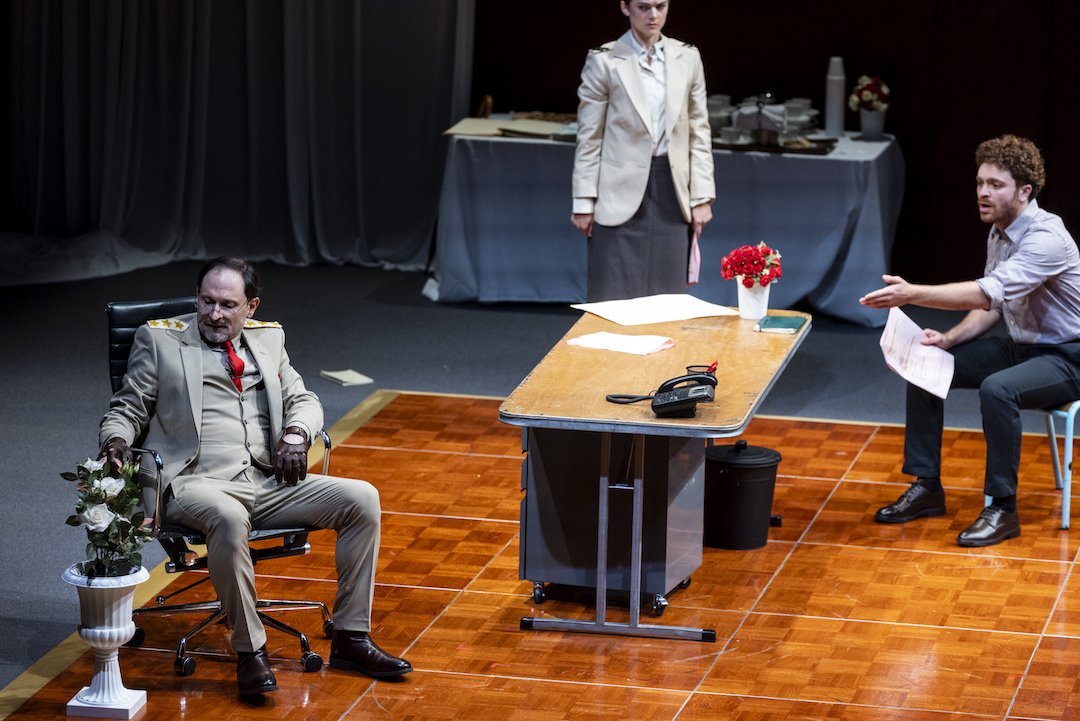
Rose Riley, Faisal Hamza, Yalin Ozucelik and Eden Falk. Photo: Brett Boardman
Monstrous veneers, naïve similitudes, brave counterfeits and radical fictions – the inescapable artifice of storytelling is the dark vortex consuming minds and lives in Sam Holcroft’s brilliant and dizzyingly kafkaesque A Mirror, first staged in London in 2023. Set in the arts ministry of a violently repressive bureaucratic regime, up-and-coming director Margaret Thanos has again proven herself, in her first Belvoir mainstage show, a force to be reckoned with. In the mirror-world she’s mounted here, truth-telling is a risky, volatile and complicated enterprise. Through plays within plays within plays, this intelligently coiled work interrogates the purpose, responsibility and power of art in an Orwellian (i.e. current-day) era; where the realities we inhabit are determined by the stories we tell ourselves.
Before we even get to our seats, the audience are also made ‘politically conscious actors’ – if not complicit, then aware and involved. As we go up the Belvoir stairs, the familiar walls of framed posters celebrating the theatre’s wide-ranging productions are crisply wrapped in brown paper, and stamped: ‘CENSORED’. Head up to the top landing, and there’s a sign celebrating the union of ‘Leyla & Joel’; ostensibly, we’re congregating as the guests of a state-sanctioned wedding. What we’re ‘really’ here to witness however, at least according to Holcroft’s conceit, is illegal underground theatre. We may leave at any time, we’re told. Several times throughout, the ‘performance’ is halted by false alarms and menacing inspections by an government militia with flashlights and bullet-proof vests.
The story this troupe is risking their lives to tell is one which centres the character of Adem (Faisal Hamza), a mechanic, former soldier, and aspirational playwright. As is mandatory procedure, he sends his first manuscript for approval to the Ministry of Culture. Its content is so scandalous – profane and pornographic – it should have landed him in the re-education camps. But young Adem has a way with words, and the high-level bureaucrat Čelik (an exceptional Yalin Ozucelik) – a man of fine taste who holds contraband Shakespeare in his drawers – is intrigued. He dreams of sculpting the man into the nation’s next great bard; much like he did for the current literary national treasure, Brix (Eden Falk).
Čelik realises only belatedly that Adem is more stenographer than storyteller. His writing is pure verisimilitude; with a infallible memory, he tells things only as they are or were. Indeed, it seems the act of fabrication is beyond him. In a regime that demands absolute fealty to delusion however, honest accounting – holding a mirror up – is seditious enough to make an otherwise obedient citizen a dangerous dissident.
Ozucelik perfectly embodies if not the banality, then the ordinariness of evil, and how cold ambition can wear its friendly masks. A clever man with his quirks, balding and silver-tongued and a little bit pathetic, Čelik (or at least the ‘actor’ playing him) hardly seems threatening. Indeed, for a while, you may hope to believe that Čelik is a subtle agitator for progress, a man on the inside. Towards his soldier-turned-secretary Mei (a sweetly gauche Rose Riley), he presents as a kind mentor, nurturing her curiosity with banned books and free tickets to the theatre. But it would be wrong to give him the benefit of the doubt.
Illusions begin to break down when Čelik invites Brix, Mei and Adem to his office to compare the two playwrights’ war-time plays. They are wildly different; one based on myths, the other a word-for-word replay of a lived event. Brix offers a spiteful analysis to Adem: ‘you throw bricks, I make buildings’.
But when a missive arrives at his house, Brix is no longer sure. Once full of promise, now a philandering alcoholic hack, he’s had a revelation brought on by Adem’s truth-telling. He rounds on Čelik: no champion of great art, but an insidious ‘seducer’ – convincing artists to carve out their insides so the nation’s charades can prosper.
The last few scenes of A Mirror are a dark, violent plunge in the underworld that was always simmering beneath the mirage. One representation implodes into another; the mirror splinters. The lighting here is close to terrifying. At one moment, at a sound off-stage, I almost flew out of my skin. The ending is harsh, uncompromising and powerful. The final line is a brute shock.
Belvoir has brought us an electrifying work of modern theatre, where all production elements conspire to fracture art and truth and power. Leave shaken, and fervently glad you experienced it.


A Mirror
Belvoir Theatre, Surry Hills
Until 22 March 2026
Photos by Brett Boardman
