Two Cents: Continuity (New Theatre)
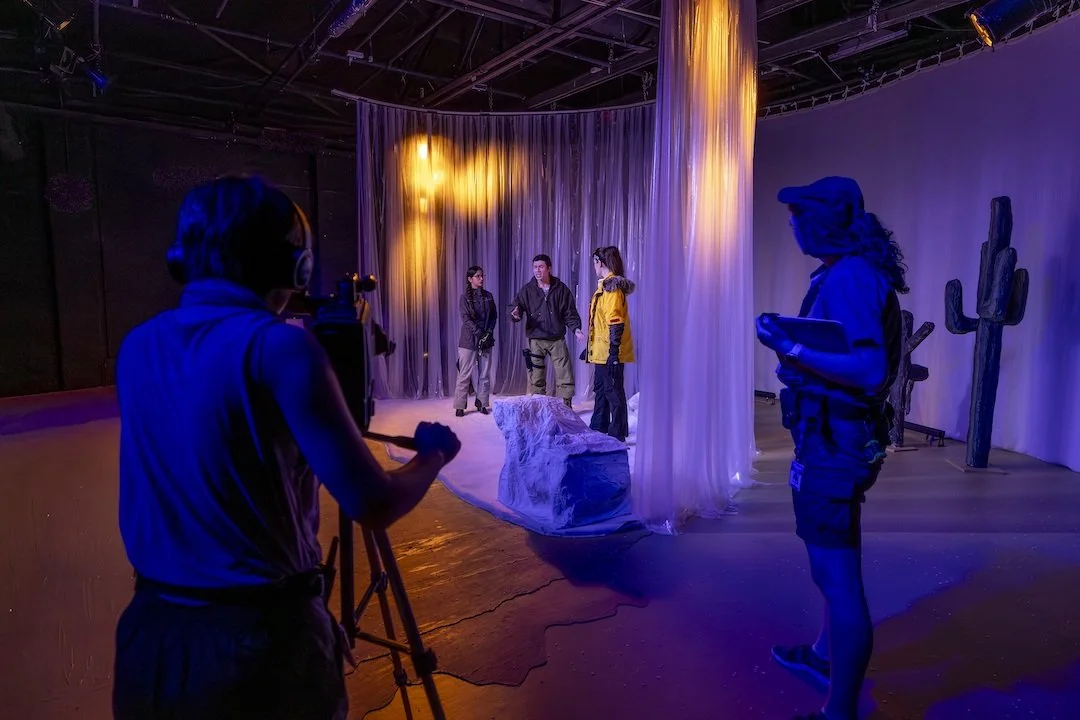
Photo: Bob Seary
On the set of a new Hollywood disaster film, shot in the blistering deserts of New Mexico, everything is coming apart. The styrofoam chunks simulating Arctic boulders. The script, which now has a renegade climate activist stealth-triggering a tsunami to force global action on climate change (‘Could work!’ offers George, playing the villain. The movie Don’t Look Up thought otherwise). The leading lady’s sobriety is also on the wobble (there’s more than one snow blower here). Also on thin ice: careers. Purpose. Hope.
The sunburned team are shooting the same scene over and over. The director’s yelling ‘action!’ but the setbacks keep mounting. And the light is fading.
Imperturbable science adviser Laurie (Susan Jordan) – who is forever popping up at inconvenient moments in a very symbolic way – isn’t helping. She was hired by Sundance-winning director Maria (Michelle Robin Anderson) to get the facts right, but the fact of the matter is: if their grand project is to rally against the coming apocalypse, then a blockbuster movie – especially one with a happy ending – is a laugh-chokingly futile way to go about it.
Disaster movie? More like distraction movie. Also, a man-induced tsunami could probably only wipe out Long Island, not all of the west coast of America – so that part needs a rewrite.
The voice of scientific reason sure is a bummer on a) entertainment value b) humanity’s future.
American playwright Bess Wohl (who won a Pulitzer earlier this year) debuted Continuity off-Broadway in 2019, and one feels both glad (for audiences) and nauseous (because irrelevancy would be ideal) that it will likely be appearing on stages worldwide for years to come. Bringing a tactfully light comic touch to discomfortingly depressing themes, Wohl’s is a modest little meta-satire that invokes some of the prickliest ethical and existential questions facing creatives today.
Questions like: do environmentally conscious artists have a responsibility to reflect ‘hard truth’ in their stories to avoid playing into climate denialists' hands? (Could come across as didactic, guilt-making or plain old pedantic.) Should such artists become activists, with their work measured by its ability to motivate? (Or does art’s integrity rely on remaining outside the messy demands of that realm? Is being apolitical even possible?) How can one speak honestly about this terrifying, systems-shackled act of reckless self-sabotage without propagating further denial, or paralysing nihilistic despair?
Is the biggest delusion of all believing that art could ‘save the world’?
I feel weary even writing such things. Fortunately, in this New Theatre production directed by Sahn Millington, there’s enough levity to counterbalance the theme-triggering lethargy. Performances could be ramped up to a little more manic-absurd, and timing could at times be tighter, but there’s still much to appreciate here. The stage (designed by David Marshall-Martin) is a particularly evocative artifice – a translucent semi-circular curtain creates the polar film set, with a couple of cacti poking conspicuously beyond the DP’s frame. Julian Dunne’s lighting is beautiful and melancholy, with soft colours palely glowing behind an alienating white.
The cast adds a necessary touch of tenderness to their characters’ foolish blinkered ways. Jessica Joseph-Mcdermott, the film-within-the-play’s prima donna, delivers an impressive coke-fueled monologue. Sarah Nader gets to play with dry wit and stage some entertaining death flops. Nick Curnow, who plays the script-writer, is sympathetic despite some bygone era behaviours. Despite a slip-slidey Texan accent, Andrew Mclaughlin shows promise as the blundering, well-intentioned young leading man.
As Laurie reminds the crew, consuming a story about climate change isn’t the same as taking action against it. Motivating or not, melodramatic as it sounds, perhaps we have to hold onto the belief that well-told stories have meaning. Bring us together. In the gathering darkness, bring us some kind of light.
As our writer half-sings, sitting beside the woman he probably still loves, the long day of filming just wrapped: ‘I hate to see the evening sun go down.’
Continuity
New Theatre, Newtown
Until 20 June 2026
