Two Cents: The Jungle and the Sea (Belvoir)
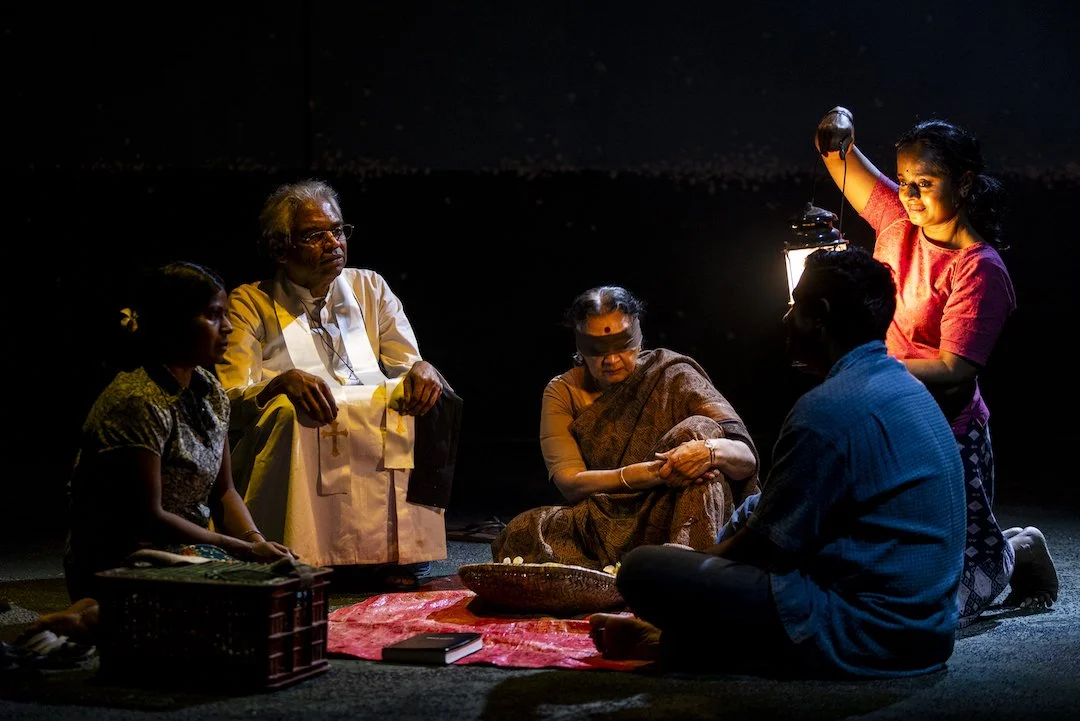
Photo: Brett Boardman
An odyssey of forced flight with no homecoming, set during the last long stretch of Sri Lanka’s bloody civil war, S. Shakthidharan and Eamon Flack’s The Jungle and the Sea (காடும்கடலும் ගණවනමුහුද) left its vivid and indelible mark on audiences when it made its world premiere on Belvoir’s main stage in 2022. It’s virtuosic, many-sided storytelling follows one Tamil family in the north of the island country, caught up in the conflict between the separatist militia Tigers and government forces – each self-righteous in their violent pursuit of what they deem justice. It returns to the same stage four years later, with the same brilliant South Asian cast and two musicians live-scoring throughout with traditional Carnatic music. An epic tragedy that draws inspiration from two ancient texts – India’s Mahābhāratha and Sophocle’s Antigone – it braids everyday characters into myth and recent political history. In doing so, it elevates narratives and lives whose humanity has been discounted – through repressive political campaigns, and through the western world’s Anglocentric indifference to the affairs of small non-white nations. Richly choreographed, spanning decades from 1995 to now, its three acts comprise a beautiful and powerful advocacy for truth-telling.
‘But there are so many truths!’ one character protests.
‘Then we will tell them all,’ another replies.
A toss of a cricket ball, a tease at a visiting admirer – we don’t get much time to get to know this big, boisterous family before they’re uprooted from their home and torn apart across continents. The father’s Christian church is bombed by the state – a scorched earth act that blinds him for life, and kills villagers he promised sanctuary. When only son Ahilan joins the militia, the matriarch Gowrie (played with unassailable dignity by Anandavalli, a renowned dancer and teacher) symbolically blinds herself too. Wrapping a band of cloth around her eyes, she pledges that she will not remove it until all her children are together again. The father (Prakash Belawadi) and youngest daughter Lakshmi (Emma Harvie) flee to Sydney Australia to start a very different life of both relative privilege and isolation. Lakshmi studies international law; her father languishes in grief and guilt. Their one dedicated scene together in Act 1 is funny and heartwarming; long as this play is, I wish there had been just one more later on.
As it is (still brilliantly), The Jungle centres on the family that remains – mother, two daughters, and one family friend – and their long search for the lost son. On the road, they encounter fellow refugees, soldiers, local members of the UN. All are in an impossible predicament.
One of the most striking features of this production is its revolving stage, which is almost always in motion. As the war pushes them further towards the coast, the family is in constant movement; there is no rest, no sanctuary, certainly no safe zone that can be trusted as such. The revolve – creaking gently as it whirls, faster then slower – makes kinetic this turbulence of place and mind, amplifying the urgency of their plight. When history repeats itself in horrors – at the hospital, on the beach, in the raging waters of the lagoon – the headstrong daughter Abirami (Kalieaswari Srinivasan) seems to become both dissociated and hyper-aware, realising her people are stuck in a loop they can’t escape. Two bands of blue – a dense, bright turquoise above a subdued teal – make vivid the theatre’s walls.
But the dynamic set also lends itself to the family’s essential animation – their humanity and individualities, defiantly undiminished even in the worst of the horrors. Take the spontaneous interfaith marriage between childhood sweethearts, as distant explosions grow close. Or Madhu’s (Nadie Kammallaweera) excited cataloguing of the birdlife around her (she would’ve been a vet had she not lost two fingers to the bombing). Or, most memorably, and in an echo to Sophocles, Abirami’s heroically unyielding demand to honour her dead.
To the right of the stage, two musicians paint and propel each scene with haunting sounds; Indu Balachandran playing an ancient, long-bodied string instrument known as a veena; composer Arjunan Puveendran on drums, including a double-headed mridangam; each improvising vocals. The effect is tremendously affecting – you come to fear the hollow beat of an isolated drum – and it’s a beautiful way to integrate South Asian culture into storytelling here. (Big respect to Belvoir for the behind-the-scenes videos by the way, which helped me give name to this music and its instruments, and a means to build understanding further.)
The Jungle and the Sea astonished me the first time I saw it, and remains one of the best theatre productions I’ve seen. I hope its return will help pave the way for more stories that open audiences up to worlds beyond the borders of our land and imaginations.


Photos: Brett Boardman
The Jungle and the Sea
Belvoir St Theatre, Surry Hills
Until 2 August 2026
Postscript
Quite by coincidence, I saw this play for a second time not long after reading Michale Ondaatje’s Anil’s Ghost, another work of fiction that reckons with the Sri Lankan government’s gross acts of violence against civilians during the civil war. It’s a terrific, haunting book, that my second viewing of this play that much richer.
